Minimalism is not just about white walls and empty floors. It is about intentionality. It is the art of removing the unnecessary so that the necessary may speak.
In a truly minimalist home, every object must justify its existence. There is no room for clutter. This creates a challenge: How do you decorate a space without “decorating” it?
The answer lies in the Japanese concept of “Ma” (Negative Space). Japanese Calligraphy is the ultimate minimalist art form—it creates a universe using only two colors: Black and White.
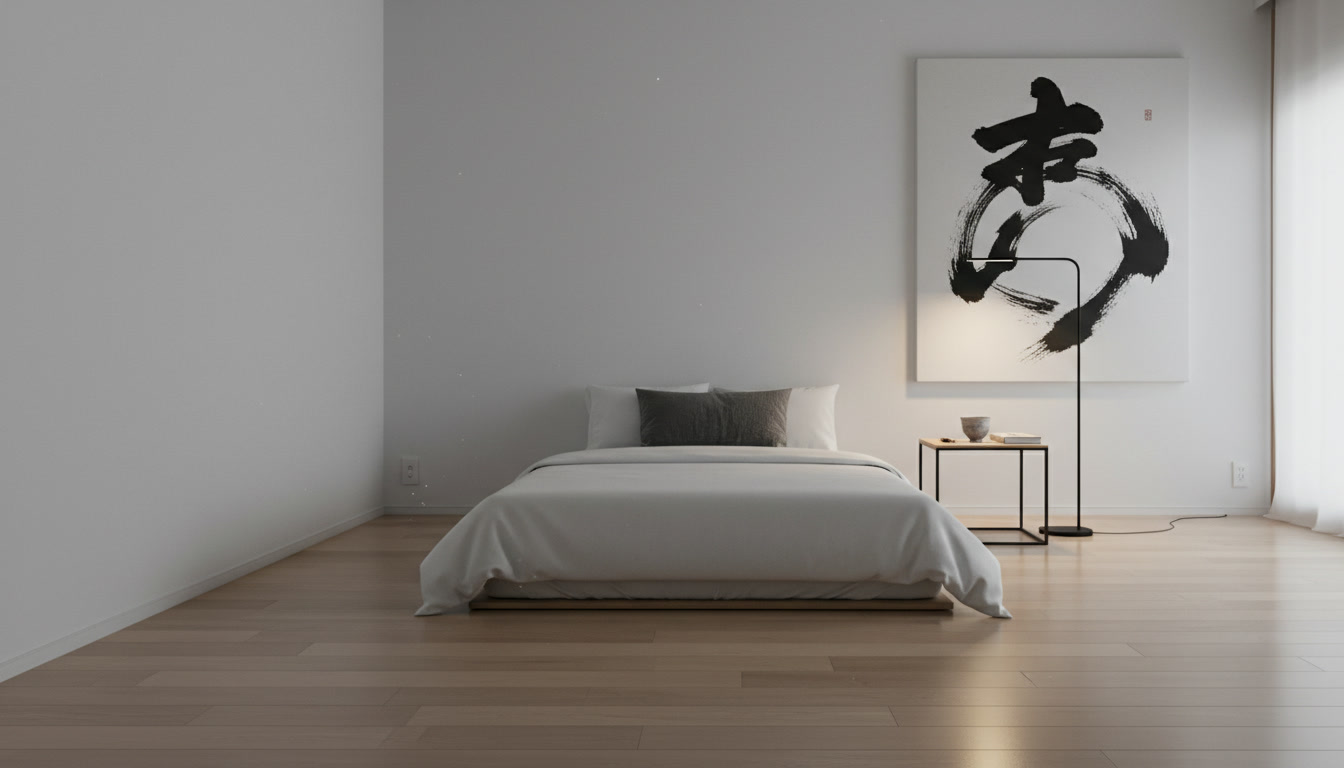
In a world of noise, silence is luxury.
1. The Art of Subtraction
Western art often focuses on covering the canvas with paint. Japanese calligraphy focuses on what is not painted. The white unpainted paper is not “empty”; it is charged with energy.
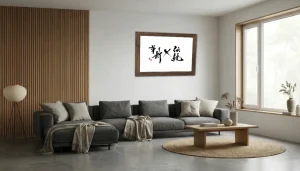
For a minimalist interior, this is crucial. A colorful oil painting might feel too “loud” or chaotic in a monochromatic room. But a stroke of Sumi ink respects the silence of the space while providing a powerful focal point. It anchors the room without cluttering it.
2. High Contrast, High Impact
Minimalist interiors often rely on a monochromatic palette (white, grey, black). Calligraphy fits this perfectly but adds something essential: Organic Texture.
Minimalist furniture tends to be geometric—straight lines, smooth surfaces, manufactured perfection.
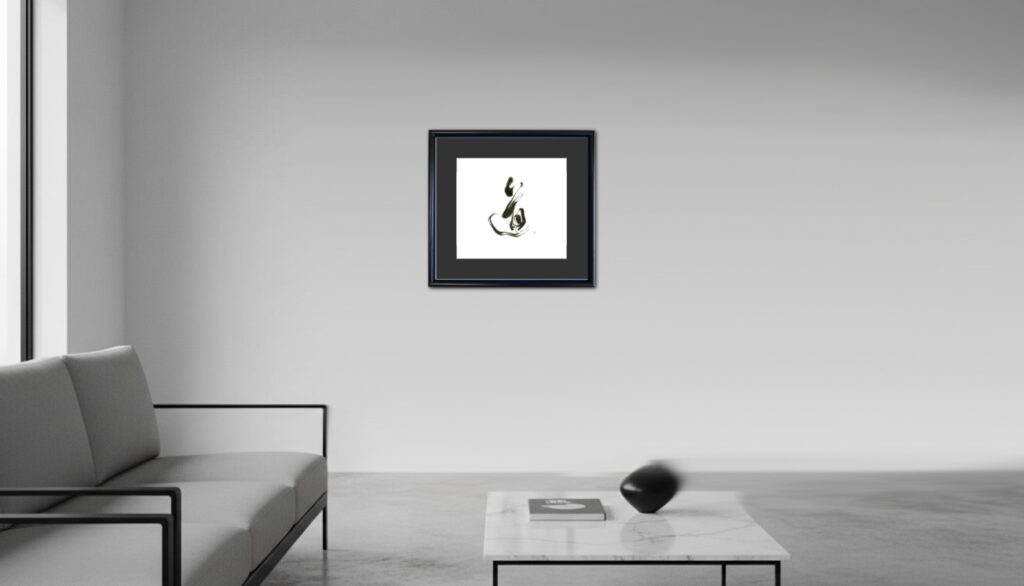
The “splash” and “blur” of calligraphy introduce a natural, uncontrollable element. This contrast between the Clean Line (Furniture) and the Raw Line (Ink) makes the space feel sophisticated rather than clinical.
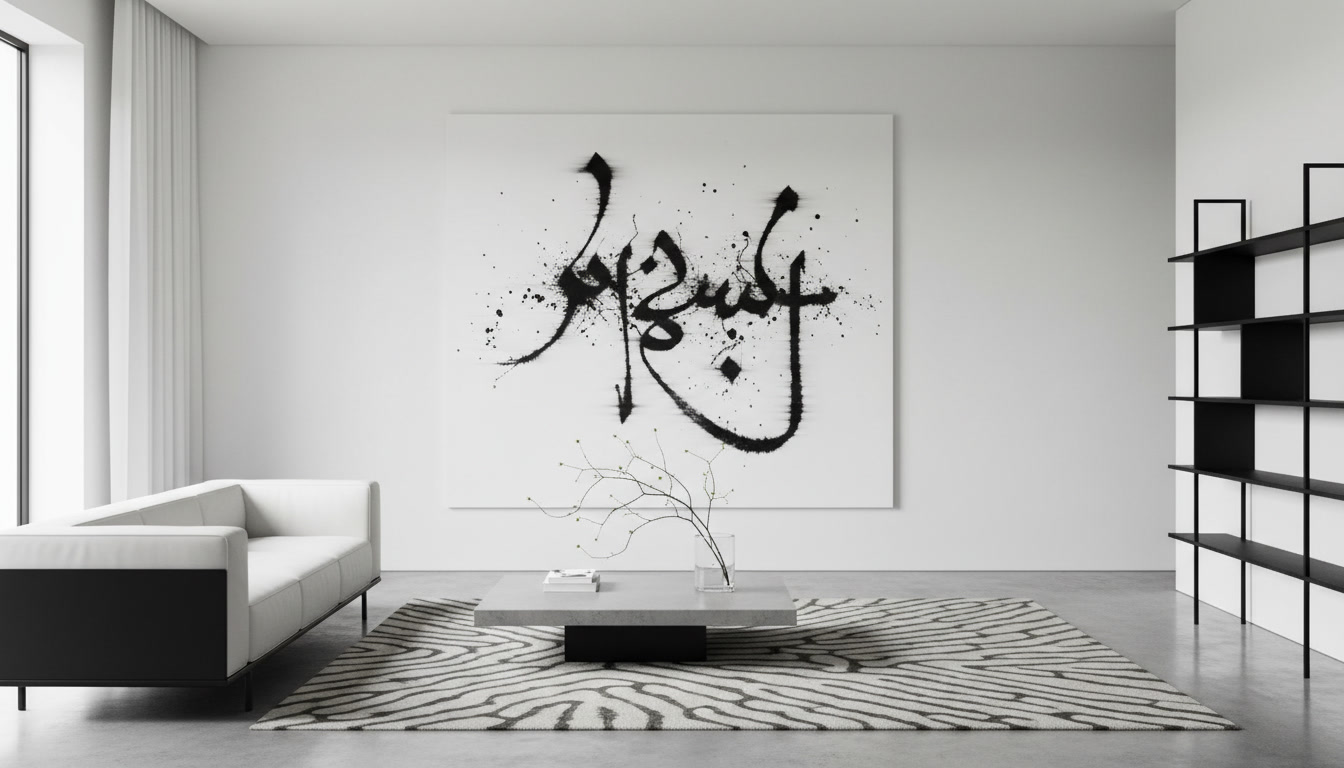
The tension between the geometric and the organic.
3. Styling Tips for Minimalists
The “One Wall, One Work” Rule
Resist the urge to create a gallery wall with many small frames. In minimalism, scale is power. Choose one large, significant piece of calligraphy and give it an entire wall to breathe. The ample wall space around the art becomes part of the artwork itself.
Framing: The Invisible Border
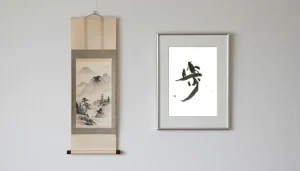
Keep the framing barely visible.
- Thin Black Metal: Creates a sharp, defining border like a pen stroke.
- Float Mounting: Raises the Washi paper slightly off the backing board, emphasizing the paper’s jagged, handmade edges (Deckle edge). This celebrates the material without adding ornamentation.
4. Recommended Works
For minimalists, we recommend works that are either:
- Single Character: A powerful Kanji like “Rin” (Dignity) or “Shin” (Core).
- Avant-Garde Stroke: A single, sweeping line that cuts through the void.
Visualize the Void
Does your minimalist home need a focal point?
Upload a photo of your empty wall to our simulator and see how a single stroke of black ink can complete your space.
「単純」のその先へ:ミニマリストの空間における「間(Ma)」の力
ミニマリズムとは、単に白い壁や何もない床のことではありません。それは「意図」の問題です。不要なものを取り除き、本当に必要なものだけを語らせる芸術です。
真のミニマリストの家では、すべてのオブジェクトがそこに存在する理由を持たなければなりません。散らかり(クラッター)の入る隙はありません。しかし、ここで一つの課題が生まれます。「どうやって空間を装飾せずに、美しく見せるか?」
その答えは、日本古来の概念「間(Ma)」にあります。書道は、黒と白の二色だけで宇宙を表現する、究極のミニマリズム・アートです。
ノイズの多い世界において、静寂こそがラグジュアリーです。
1. 「引き算」のアート
西洋絵画の多くは、キャンバスを絵具で「埋める」ことに注力します。対して書は、「書かないこと」に焦点を当てます。墨が乗っていない白い紙は、単なる「空白」ではありません。そこにはエネルギーが充満しています。
ミニマリストのインテリアにとって、これは極めて重要です。色彩豊かな油絵は、モノトーンの部屋には「うるさく」感じられることがあります。しかし、一筆の墨は、空間の静寂を尊重しながら、強力なフォーカルポイント(視線を集める点)となります。それは部屋を散らかすことなく、引き締めるのです。
2. ハイコントラスト、ハイインパクト
ミニマリストのインテリアは、白、グレー、黒といったモノトーンのパレットに頼ることが多いものです。書はこの配色に完璧にフィットしますが、さらに重要な要素を一つ加えます。それは「有機的なテクスチャ」です。
ミニマルな家具は幾何学的になりがちです。直線、滑らかな表面、工業的な完璧さ。
書の「飛沫」や「滲み」は、そこに自然で制御不能な要素を持ち込みます。「家具のきれいな直線」と「書の生々しい線」の対比が、空間を病院のような冷たい場所ではなく、洗練された住まいへと変えるのです。
幾何学と有機性の緊張関係。
3. ミニマリストのためのスタイリング術
「一壁、一作品」のルール
たくさんの小さなフレームを並べてギャラリーウォールを作りたい欲求を抑えてください。ミニマリズムにおいて、スケール(大きさ)は力です。一つの大きく、意味のある書を選び、壁全体をその作品のために使います。アートの周りの広い壁面もまた、作品の一部となるのです。
額装:見えない境界線
フレームは極力目立たないものを選びます。
- 極細の黒いメタルフレーム:ペンの線のように、鋭く空間を切り取ります。
- 浮かし額装(Float Mounting):和紙を台紙からわずかに浮かせて固定する方法です。和紙の手漉きならではの「耳(デッキルエッジ)」の凹凸が影を落とし、装飾を加えることなく素材の美しさを称賛できます。
4. おすすめの作品スタイル
ミニマリストの方には、以下のいずれかのスタイルを推奨します。
- 一文字の書:「凛」や「芯」など、自分の核となる漢字一文字。
- 前衛的な一筆:虚空を切り裂くような、一筆書きの抽象作品。
「無」を視覚化する
あなたのミニマルな家に、魂の入る場所はありますか?
何もない壁の写真をシミュレーターにアップロードして、たった一筆の黒いインクが、いかにして空間を完成させるかを目撃してください。