Mission, Vision, Values (MVV). Every company has them, but how many employees truly embody them? Often, these guiding principles remain as text on a website or a dusty plaque in a hallway, forgotten in the daily grind.
To build a strong corporate culture, you need to move the philosophy from the “Page” to the “Space.” In Vol.3 of “Success & Strategy,” we explore how displaying calligraphy in meeting rooms and cafeterias acts as a powerful tool for Inner Branding and team unity.
Philosophy creates the atmosphere where decisions are made.
1. The Silent Facilitator in the Meeting Room
The meeting room is where conflicting opinions clash and decisions are forged. In these moments of heat, art can serve as a “Silent Facilitator.”
A powerful piece of calligraphy stating a core value—such as “Integrity” (誠) or “Challenge” (挑)—anchors the discussion. It reminds participants of the “North Star” they are aiming for, helping to align disparate views toward a common goal.
2. Case Studies: Art that Connects People
Chosho Yabe has helped companies turn their spaces into hubs of communication and shared values.
Case A: A Shared Mindset Across 20 Branches
Client: Jukyo Holdings Co., Ltd.
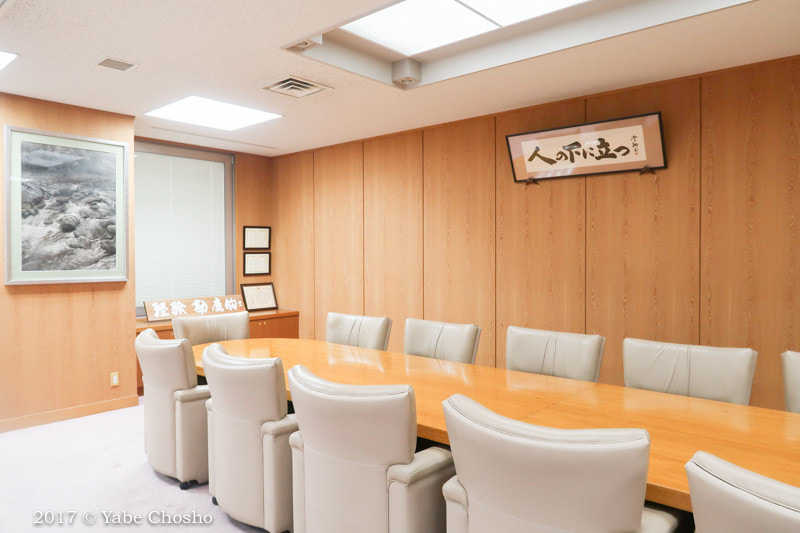
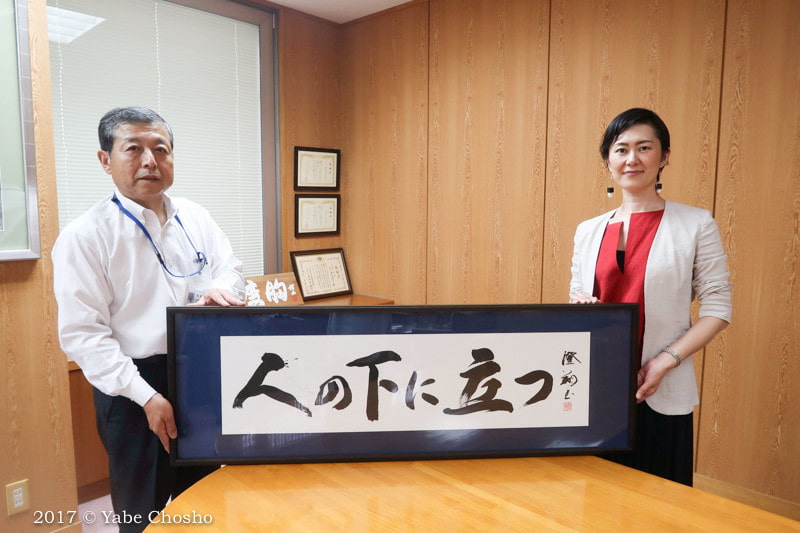
Real estate developer Jukyo Holdings wanted to unify the mindset of employees across their 20 branches. The chosen motto was “Hito no shita ni tatsu” (Standing Below People).
This counter-intuitive phrase embodies “Servant Leadership”—supporting customers and society from the foundation. By displaying this calligraphy in every branch, it serves as a daily visual reminder of their service philosophy, uniting the team under one spirit.
Case B: The Cafeteria as a Gallery
Client: Taiyo Holdings Co., Ltd. (Ranzan Cafeteria)
When Taiyo Holdings built a new cafeteria using local timber, the President had a vision: “Polish employees’ sensibilities through art to inspire better manufacturing.”
We curated the space with works like “Sun” (Taiyo), “Create” (So), and “Storm” (Arashi). The cafeteria became more than a place to eat; it became a gallery where art sparks conversation and creativity among staff, fostering a sense of community.
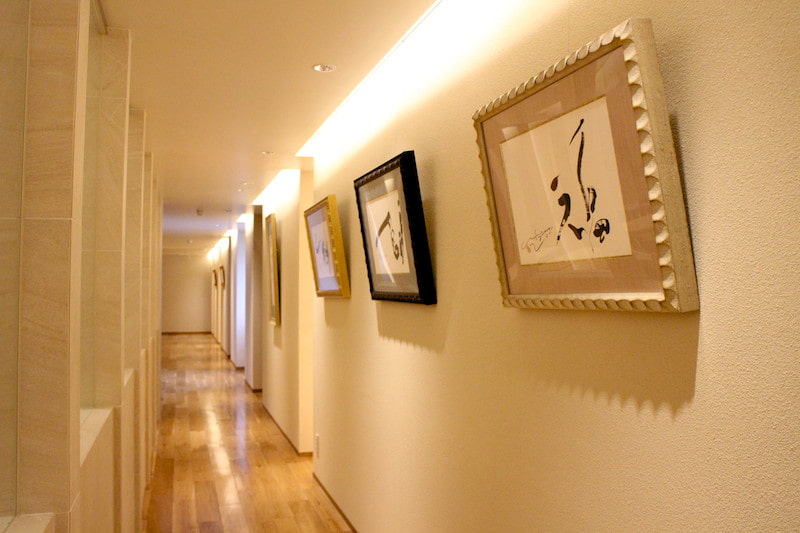
Case Study: Taiyo Holdings. Art nourishes creativity during breaks.
3. The “Mere Exposure Effect”
Psychologically, the “Mere Exposure Effect” states that people develop a preference for things simply because they are familiar with them.
By placing your corporate philosophy as art in shared spaces (hallways, break rooms), employees see it subconsciously multiple times a day. Over time, these values are internalized naturally, not forced.
4. Designing for Engagement
Don’t just print your mission statement. Make it Art.
Whether it is a dynamic character in the break room to boost energy, or a calming “Harmony” in the boardroom to reduce conflict, use the power of ink to engineer your company culture.
Visualize Your Culture
How would your team react if your core values were beautifully visualized on the wall?
Upload a photo of your meeting room or office lounge to our simulator and see the impact of philosophy-driven art.
ビジョンの可視化:企業理念を「アート」にしてチームを一つにする
ミッション、ビジョン、バリュー(MVV)。どの企業にもありますが、それを心から体現できている社員は何人いるでしょうか? 多くの場合、これらの指針はウェブサイトのテキストや、廊下の額縁の中で埃をかぶり、日々の業務の中で忘れ去られてしまいます。
強い企業文化を築くためには、理念を「紙の上」から「空間」へと移行させる必要があります。シリーズ第3弾では、会議室や社員食堂に書を飾ることが、いかにして強力なインナーブランディングとなり、チームの結束を高めるかを探ります。
理念というアートが、意思決定の場の空気を作ります。
1. 会議室の「沈黙のファシリテーター」
会議室は、異なる意見がぶつかり合い、重要な決定がなされる場所です。議論が白熱した時、アートは「沈黙のファシリテーター(進行役)」として機能します。
「誠」や「挑」といったコアバリューを示す力強い書が目に入れば、それは議論のアンカー(碇)となります。参加者に目指すべき「北極星」を思い出させ、バラバラな意見を共通のゴールへと導く助けとなるのです。
2. 導入事例:人と人を繋ぐアート
矢部澄翔は、企業のアート導入を通じて、コミュニケーションと価値観の共有を支援してきました。
事例A:20拠点を繋ぐ共通のマインドセット
株式会社住協ホールディングス様
20ある支店の社員の意識を統一したいというご要望でした。選ばれた社是は「人の下に立つ」。
これは「サーバント・リーダーシップ(お客様や社会を土台から支える)」を意味する、逆説的で深い言葉です。全支店にこの書を掲示することで、物理的に離れていても、社員たちは毎日同じ精神に触れ、一つのチームとしての誇りを共有しています。
事例B:ギャラリーとしての社員食堂
太陽ホールディングス様(嵐山食堂)
地元の木材を使った社員食堂を新設した際、社長には「アートを通じて社員の感性を磨き、より良いモノづくりに繋げたい」というビジョンがありました。
そこで私たちは、「太陽」「創」「嵐」といった作品で空間をコーディネートしました。食堂は単なる食事の場を超え、アートが社員同士の会話や創造性を刺激する、コミュニティの中心地となりました。
事例:太陽ホールディングス様。休息の時間に、アートが創造性を養います。
3. 「単純接触効果」を味方につける
心理学には「単純接触効果(ザイアンス効果)」という法則があります。人は、繰り返し接するものに対して好意や親近感を抱くというものです。
企業理念をアートとして共有スペース(廊下や休憩室)に配置することで、社員は毎日無意識にそれを目にします。強制されるのではなく、自然な形で価値観が刷り込まれ、内面化されていくのです。
4. エンゲージメントをデザインする
ミッション・ステートメントをただ印刷して貼るのはやめましょう。それを「アート」にしてください。
休憩室には活力を与えるダイナミックな文字を、役員会議室には衝突を鎮める「和」の文字を。墨の力を借りて、企業文化を戦略的にデザインしましょう。
企業文化を視覚化する
もし、あなたのチームのコアバリューが美しく可視化され、壁に飾られていたら、社員の意識はどう変わるでしょうか?
会議室やラウンジの写真をシミュレーターにアップロードして、理念アートのインパクトを確認してみてください。